
 Get In Touch
 (423) 355-1091
Summer in Chattanooga has a way of testing a roof harder than any other season. The heat builds early, sits high through July and August, and works on shingles and seals day after day. Then the afternoon storms roll in off the ridges, and the wind and hail finish what the heat started. By the time most homeowners think about the roof, it is already August, the leak has already shown up, and every roofing company in town is booked solid.
This guide is for the homeowner who would rather get ahead of that. If you have been searching summer roof inspection Chattanooga TN, roof heat damage Tennessee, how long does a roof last in Tennessee, when should I call a roofer, or free roof inspection Chattanooga, the next fifteen minutes will tell you what summer actually does to a roof, the signs most people miss, and why now is the calmest, smartest time of year to have someone take a look.
We are CH Roofing. We have been working on roofs across the Chattanooga area for more than thirty years combined. We are GAF certified, fully licensed and insured, and we offer free roof inspections, free leak detection, and same-day estimates. Our team speaks English and Spanish. We are not the loudest roofing service in Chattanooga. We are the one your neighbors quietly recommend. Local. Reliable. Built on trust.
Quick Answer: Why Summer Is the Most Important Season for Your Roof
If you only read one section, read this one. Summer is the season your roof takes the most punishment, and the season most homeowners pay the least attention to it. The heat accelerates the aging of shingles and dries out the sealants that keep water out. The storms that come with Tennessee summers add wind and hail on top of an already stressed roof. And the damage that starts now usually does not announce itself until a heavy rain in the fall finds the weak spot.
The smart move is simple. Have your roof looked at before the worst of the season, not after. A free CH Roofing inspection takes 30 to 60 minutes, costs nothing, and tells you exactly where your roof stands. If everything is fine, you get peace of mind. If something needs attention, you catch it while it is small and while the schedule is still open. That is the entire case for a summer inspection, and the rest of this guide fills in the why behind it.
How Tennessee Summer Heat Wears Down a Roof
Heat is the quiet damage. Wind tears a shingle off in a way you can see from the driveway. Heat works slower and out of sight, which is exactly why it gets missed. On a hot Chattanooga afternoon, the surface of a dark asphalt roof can run far hotter than the air temperature, and it does that day after day for months.
Heat and UV accelerate shingle aging
Asphalt shingles rely on a layer of protective granules and a flexible asphalt mat underneath. Constant heat and ultraviolet exposure dry that mat out and loosen the granules. You start to see granule loss in the gutters, shingles that look faded or brittle, and edges that begin to curl or lift. Every one of those is the roof telling you it is aging faster than the calendar says.
Heat dries out the seals around penetrations
The places where a roof most often leaks are not the wide open fields of shingles. They are the details: the flashing around the chimney, the boots around plumbing vents, the seals at skylights and valleys. Heat dries and cracks those sealants over time. A boot that was fine last year can split this summer, and you would never know until water follows it down into the ceiling.
Attic heat works on the roof from below
A roof gets cooked from both sides in summer. A hot, poorly ventilated attic bakes the underside of the decking and shortens the life of the whole system. If your upstairs rooms are hard to cool and your attic feels like an oven, that heat is part of your roof’s story, and it is worth understanding during an inspection.
What Summer Storms Add on Top of the Heat
Tennessee summers do not just bring heat. They bring fast, hard afternoon storms with wind, heavy rain, and hail. The trouble is that those storms land on a roof that the heat has already weakened, so the same storm does more damage in August than it would have in April.
Wind lifts and peels shingles, especially along edges and ridges that are already curling from the heat. Hail bruises and fractures shingles, knocking granules loose and creating soft spots that fail later. Heavy rain finds every dried-out seal and every lifted edge and drives water where it does not belong. None of these are dramatic on the day they happen. They show up weeks later as a stain on a ceiling.
This is why a roof that looked fine in June can be a problem by September. The storm did the damage in July, and the heat set it up. Catching it early is the difference between a small repair and a much larger one.
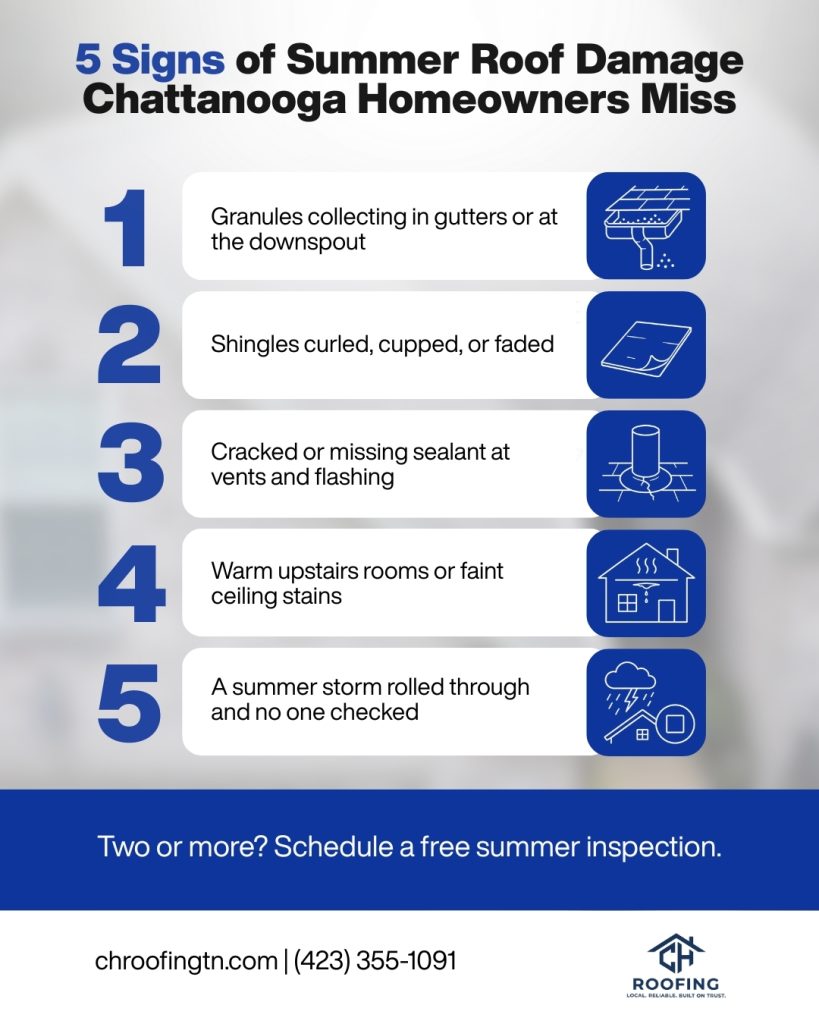
Five Signs of Summer Roof Damage Homeowners Miss
Most summer roof damage is visible from the ground if you know what to look for. None of these on its own means trouble. Two or three of them together is a good reason to schedule a free inspection.
1. Granules are collecting in your gutters or at the downspout
After a hard summer rain, look at what washes out of the downspout. A buildup of sandy, dark granules means your shingles are shedding their protective layer faster than they should, often a sign of heat aging or hail.
2. Shingles that look curled, cupped, or faded
Walk to the curb and look at the roof in good light. Edges that lift or curl, shingles that look dried out or discolored, and patches that no longer lie flat are all heat and age showing through.
3. Cracked or missing sealant around vents and flashing
The rubber boots around plumbing vents and the sealant along flashing are common first failures in summer. From the ground, you may not see it, but it is one of the first things an inspector checks.
4. Interior signs: warm upstairs rooms or faint ceiling stains
Rooms that will not cool and faint discoloration on a ceiling or in a closet can both trace back to the roof. The stain is rarely directly under the leak, which is why people miss it.
5. A storm rolled through, and you never had it checked
If a wind or hail event hits your neighborhood this summer and no one has looked at your roof since, that alone is reason enough. Storm damage is often invisible from the ground and easiest to document while it is fresh.
Why a Free Inspection Now Beats an Emergency Call in August
There is a real difference between calling a roofer. You want to and are calling because you have to. A planned summer inspection is a calm, no-pressure visit on your schedule. An August emergency call usually means water is already in the house, the damage is bigger, and every good roofer in Chattanooga is buried in storm work.
A free inspection now puts you in the first category. We come out, we look carefully, and we tell you in plain English what we find. If the roof is healthy, you have your answer, and you move on. If there is a small issue, we catch it while it is cheap to fix and while we can still get to it quickly. Either way, you are deciding on your timeline instead of reacting to a ceiling stain at the worst possible moment.
Repair or Replace: Making the Right Call This Summer
Summer is when a lot of homeowners face the repair-or-replace question, usually after an inspection turns something up. The honest answer always comes down to three things: how old the roof is, what kind of damage is showing, and what is happening underneath the shingles where you cannot see.
Repair is usually the right call when the roof is under fifteen years old, the damage is contained to one area, and the cause is identifiable and isolated. A few shingles after a storm, a single failed flashing detail, a contained leak: those are repairs, and they are a fraction of the cost of a replacement.
Replacement becomes the smarter long-term move when the roof is past eighteen years for asphalt or fifty-plus for metal, when several sections are wearing out at once, when there are repeated leaks in different places, or when a major storm has triggered an insurance claim. At that point, patching tends to buy diminishing returns.
We will never push you toward a replacement you do not need. Our job at the inspection is to show you what is actually going on and let the facts make the call. Most of the time, the roof itself answers the question once you can see it clearly.
Residential Roofing in the Tennessee Heat: Asphalt, Metal, and Tile
Material matters more in a hot, humid, storm-prone climate like ours than the national averages suggest. Here is how the common choices hold up around Chattanooga.
Asphalt shingles: the practical default
Architectural asphalt shingles are the most common roof in the area for good reason. They balance cost, looks, and durability, and a quality GAF system performs well here. The trade-off is that Tennessee heat and humidity tend to push asphalt toward the lower end of its lifespan range, which is why ventilation and timely repairs matter so much.
Metal roofing: longer life, higher up-front cost
Metal roofs handle summer heat and storms exceptionally well. They shed rain, stand up to wind and hail, and reflect heat in a way that can ease the load on a hot attic. The up-front cost is higher, but the lifespan is far longer, which makes metal a strong long-term value for many homeowners.
Tile: distinctive and long-lasting, less common locally
Tile is durable and striking and can last for decades, though it is less common in the Chattanooga area and carries weight and structural considerations. If you are drawn to it, an inspection can tell you whether your home is a good candidate.
Commercial and Low-Slope Roofs: Why Summer Is Hard on Them
Summer is not just a residential problem. Flat and low-slope commercial roofs take heat differently than a pitched home, and the consequences of ignoring them are often bigger. Standing heat, ponding water after storms, and seams that expand and contract all day can open up a low-slope roof in a single hot season.
CH Roofing installs and services the common commercial systems: TPO (a single-ply membrane that reflects heat well), EPDM (a durable rubber membrane), and Modified Bitumen (a layered, asphalt-based system). Each has strengths, and the right choice depends on the building, the existing roof, and how the space is used.
For a business owner or property manager, summer is the right time to get a commercial roof on a maintenance footing before the heaviest storm activity. A short inspection now can prevent a closed business and an emergency call later.
What a CH Roofing Free Inspection Actually Covers
A free inspection should be more than a glance from the driveway. Here is what ours looks like, step by step.
- We talk with you first about what you have noticed and any history with the roof.
- We walk the property at ground level, checking the roofline, gutters, and downspouts.
- We get on the roof for a thorough surface check of shingles, ridges, and valleys.
- We check every flashing and penetration, the most common leak points in summer.
- We review the gutters and drainage and look for granule loss.
- We check the attic when it is safely accessible, where heat and moisture tell the real story.
- We document what we find with photos so you can see it for yourself.
- We walk you through everything in plain English, with no pressure and no jargon.
- We provide a same-day written estimate if you want one, and we price-match written competitor estimates.
Storm Damage and Insurance: What We Do (and Don’t Do)
What we do. If a summer storm has damaged your roof, we inspect it, document the damage clearly with photos, and give the insurance adjuster the information they need to do their job accurately. We help homeowners understand the inspection and documentation side of a claim so the process is less stressful.
What we don’t do. We do not negotiate payouts, settlement figures, or claim amounts with your insurance company. That part is between you and your carrier. We focus on the roof and on honest documentation. That is the line we draw, and it has served our customers well for more than thirty years.
If a storm just rolled through your area, the most useful thing you can do is have the roof looked at while the damage is fresh and easy to document. Call us and we will get you on the schedule.
Why Local and GAF Certified Matters in Chattanooga
Roofing is a local business done right. A local roofer knows what Tennessee Valley humidity, summer heat, and spring and summer storms do to a roof, responds faster when something goes wrong, and is accountable to the same community you live in.
CH Roofing is locally owned and operated, GAF certified, and fully licensed and insured. GAF certification means meeting a major manufacturer’s quality standards and being able to offer enhanced warranty options on qualifying installations. Paired with our own workmanship warranty, that gives Chattanooga homeowners real protection, not just a handshake.
Serving Chattanooga, Athens, Collegedale, Dayton, Dunlap, and South Pittsburg
We serve Chattanooga and the surrounding communities across the Tennessee Valley, including Athens, Collegedale, Dayton, Dunlap, South Pittsburg, and the surrounding 75-mile area. If you are not sure whether your address falls inside our service area, give us a call at (423) 355-1091 and we will let you know. Wherever you are in the region, summer is working on your roof the same way, and a free inspection is one phone call away.
Why Summer Is the Smartest Booking Window of the Year
Summer is the best window of the year for a roof inspection in Chattanooga, and not only because of the weather. A few specific reasons stand out:
- Spring storm damage is fully visible now and easy to document while it is fresh.
- Storm season is building but has not yet peaked, so any decision can be made on a planned timeline rather than a reactive one.
- Heat reveals weak spots in shingles, seals, and ventilation that hide in cooler months.
- Roofers are less booked now than they will be in late summer, when the schedule fills with emergency calls.
- Catching a small concern now is far simpler and less costly than handling interior damage later.
If your roof is past fifteen years old, or if a storm has rolled through and you have been meaning to have it checked, this is the calmest week of the year to make that call.
Final Thought and How to Schedule
Summer does its hardest work on a roof quietly, and the homeowners who come through it best are the ones who got ahead of it. You do not need to wait for a leak or a storm to find out where your roof stands. You just need someone to take an honest look.
Here is the simplest possible next step. Schedule a free summer roof inspection. We come out, we look carefully, we tell you what we find in plain English, and we give you a same-day written estimate if you want one. The whole visit takes 30 to 60 minutes. No pressure. No follow-up sales sequence if it is not the right time. Just the honest answer from a Chattanooga family-owned roofing company that has been doing this for more than thirty years combined.
Three ways to schedule:
- Call us at (423) 355-1091 (24-hour emergency service available)
- Visit chroofingtn.com and request an inspection through the site
- Email us at ebowen@chroofingtn.com
CH Roofing LLC | Chattanooga, TN | (423) 355-1091 | chroofingtn.com | Locally owned and operated. 30+ years of combined experience. GAF certified. Licensed and insured. We speak English and Spanish. Free roof inspections. Same-day estimates. 10-year workmanship warranty. 24-hour emergency service. 4.9 stars across 111 Google reviews. Serving Chattanooga, Athens, Collegedale, Dayton, Dunlap, South Pittsburg, and the surrounding 75-mile area.


